
Pawnee County Arrest Records and Filed Charges
Pawnee County arrest records begin on the law enforcement side. The Pawnee County Sheriff's Office, led by Sheriff Larry Atteberry, is tied to arrests, custody, warrants, civil process, jail care, and courthouse security. The sheriff page gives the sheriff and jail address as 116 W 8th Street, Larned, KS 67550, with phone 620-285-2211. That channel is the practical first stop for current custody, booking status, and jail questions. It is not the same record as a filed criminal case.
Charges after arrest move into the court and prosecutor path. Pawnee County District Court holds the case file when a state criminal case is opened, while the Pawnee County Attorney decides and prosecutes charges for state or county matters. The County Attorney is Douglas W. McNett, with office space on the 3rd Floor at 715 Broadway Street in Larned and phone 620-285-2139. Once a complaint, information, citation, or amended charge is filed, the charge record is read through the court docket and public case record. The complete case outcome belongs with the Pawnee County criminal court records file.
Search Pawnee County Charges After Arrest
The main public path for court charges after arrest is Kansas CaseSearch, the official Kansas public district court case search. Use it for Pawnee County District Court cases when the charge has become a public district court record and the case data is available online. The courthouse terminal and the District Court clerk remain important because older files, sealed items, restricted documents, certified copies, and some records not exposed online still require clerk help at the Pawnee County Courthouse.
- Start with the exact name, citation number, or case number if one is available.
- Search Kansas CaseSearch for the Pawnee County District Court case.
- Open the public case result and review the charge or count list, docket events, and status.
- Call Pawnee County District Court at 620-285-6937 when the record is missing, sealed, older, or needs a certified copy.
- Use the sheriff or jail phone for current booking questions, not the court portal.
Municipal ordinance charges follow a different path. The City of Larned Municipal Court handles Larned traffic, fire code, property violation, and other misdemeanor ordinance matters, while more serious criminal matters route to District Court. Municipal Court is at 417 Broadway, phone 620-285-8500, and its local page says court is held the 1st and 3rd Thursday of each month.
Pawnee County Charging Documents
A charge record starts when a formal accusation is filed. Research for Pawnee County identifies complaints, amended complaints, information, citations, docket charge lists, and prosecutor filings as the usual places where charge details can appear. A charge may include the statute or ordinance number, offense description, severity level, misdemeanor or felony class, filing date, arrest agency, bond amount, and later disposition. One arrest can lead to no filed charge, one charge, or several counts.
| Document | Who Uses It | What It Can Show | Pawnee County Access Point |
|---|---|---|---|
| Complaint | Prosecutor or law enforcement filing path | Initial count, statute, allegation, date, and defendant | District Court case file or CaseSearch when public |
| Information | County Attorney | Formal prosecutor charge, often after review | District Court clerk and public docket if available |
| Citation | Officer or municipal/state traffic process | Ticket number, ordinance or statute, court date, and fine path if payable | District Court, Central Payment Center, or Larned Municipal Court |
A criminal charge document is not a conviction record. It is the filed allegation at that point in the case. Later docket entries may show amendment, dismissal, diversion, plea, verdict, sentence, warrant activity, bond review, or probation events. For custody detail, use the Pawnee County inmate records path because the jail side and the court side answer different questions.
Pawnee County Charge Status
Charge status changes are common in criminal records. A count may start as filed, then change after prosecutor review, plea talks, diversion approval, trial, or dismissal. Kansas court records may also show events such as complaint filed, first appearance, arraignment, motion filed, order entered, bond set, warrant issued, sentencing, probation review, warrant recalled, or notice of appeal. Each event is part of the timeline, but the final meaning depends on the disposition for each count.
| Status | Plain Meaning | What to Check Next |
|---|---|---|
| Pending | The charge is filed and not yet finally resolved. | Next hearing, bond terms, motions, and court date. |
| Amended | The prosecutor or court record changed the count, statute, class, or wording. | Compare original and amended counts before drawing conclusions. |
| Reduced | The charge moved to a lesser offense or lower severity level. | Read the plea, diversion, or disposition entry. |
| Dismissed | The count was ended by court order or prosecutor action. | Look for whether dismissal was with or without prejudice. |
| Diverted | Prosecution is paused under an agreement that can lead to dismissal if terms are met. | Check the Pawnee County Attorney policy and court docket. |
Note: A case can have more than one count, so one dismissed charge does not always mean the entire case ended.
Pawnee County Attorney Diversion Facts
The Pawnee County Attorney page says the County Attorney prosecutes or defends civil or criminal suits in which the state or county is a party or interested. The diversion policy adds local detail for charge records because diversion affects how a charge may appear in the docket. Diversion is an agreement that can pause prosecution and may lead to dismissal if all terms are completed. It is not automatic, and prosecutor approval controls eligibility.
Known Pawnee County diversion fees from the policy include a $150 diversion fee plus court costs and booking or fingerprint fee for misdemeanor cases, worthless check cases at $50 plus costs and booking or fingerprint fee, juvenile cases at $150 plus costs and booking or fingerprint fee, and DUI first offense at $350 plus court costs, booking or fingerprint fee, mandatory fine, and ADSAP fee paid to the provider. Misdemeanor traffic diversion is listed at $150 plus court costs and fines. Speeding diversion fees range from $50 for 0-9 mph over to $250 for 25-30 mph over.
Diversion details matter because the public charge trail may not look like a normal conviction path. A Pawnee County docket can show the filed count, later hearings, payments, supervision, and eventual dismissal or sentencing events. The court record should be read with the County Attorney policy and the final court disposition together. If a charge was diverted, reduced, or dismissed, the wording of the disposition is more important than the first arrest label.
Pawnee County Charges vs Convictions
A charge is an accusation. A conviction is an outcome after a guilty plea, no contest plea accepted as a conviction, verdict, or other court result treated as a conviction. Pawnee County arrest records, filed charges, and convictions may all be connected to the same event, but they answer different questions. The distinction is critical when reading employer screens, court dockets, expungement papers, and diversion records.
| Point | Charge | Conviction |
|---|---|---|
| Record stage | Filed after arrest, citation, or prosecutor review. | Entered after plea, verdict, or qualifying court finding. |
| Proof level | Allegation based on probable cause or prosecutor filing choice. | Final guilt finding under criminal procedure. |
| Can change | May be amended, reduced, dismissed, or diverted. | May later be appealed, corrected, set aside, or expunged if law allows. |
| Where read | Charging document, charge list, citation, or docket count. | Disposition, journal entry, sentencing order, or final docket entry. |
Pawnee County Charge Alternatives
The 24th Judicial District includes a treatment court resource. The Kansas Judicial Branch specialty courts page explains statewide specialty court categories. Pawnee County is part of the 24th Judicial District, so local eligibility questions should go through counsel, the prosecutor, court staff, or supervision channels, not through guesswork from a web search.
The Kansas Judicial Branch specialty courts page is the source for this assigned Pawnee County court charges image.
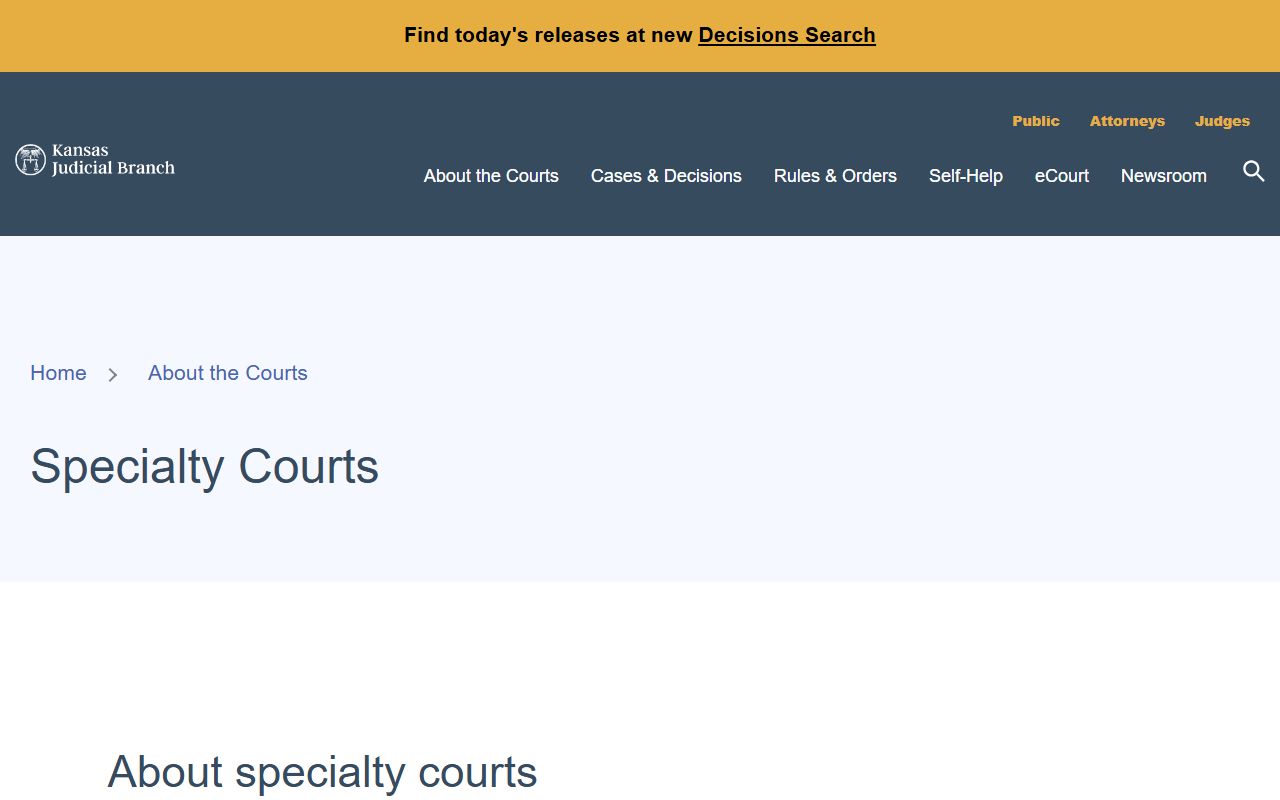
Specialty court context helps explain why a charge record may show supervision, treatment, review hearings, or dismissal events instead of a simple plea-to-sentence path.
The Kansas Judicial Branch drug court page is the source for the second assigned Pawnee County court charges image.
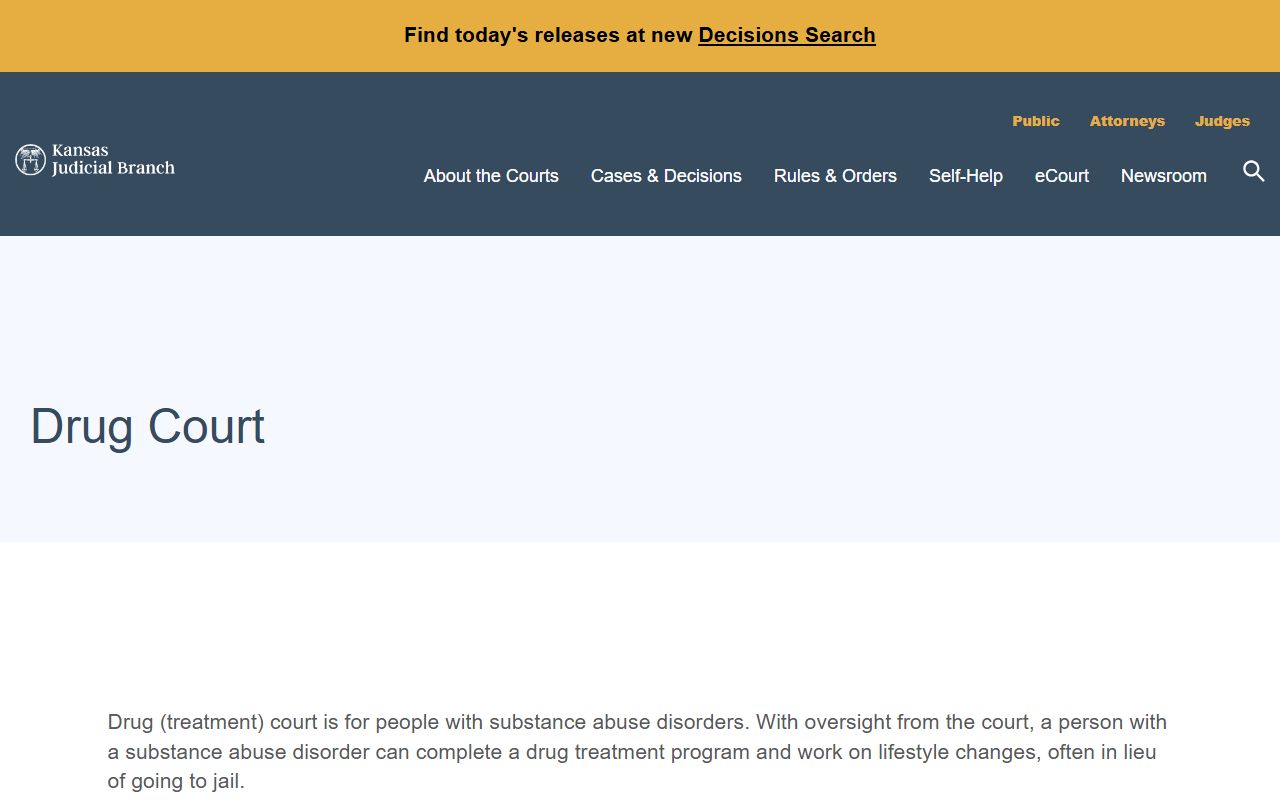
Drug court and diversion facts should be read as possible charge-resolution context, not as proof that every Pawnee County case qualifies.
Pawnee County Arrest Record Access Limits
Kansas public access rules do not make every arrest or charge detail open online. K.S.A. 45-215, K.S.A. 45-218, and K.S.A. 45-219 frame Kansas Open Records Act access, inspection, refusal, copy, and fee issues. Court records also depend on Kansas court rules, including public access limits for electronic district court records. A sealed document, juvenile case, protected address, medical fact, Social Security number, financial account number, or other restricted data may be withheld or redacted.
Adult expungement is another limit. K.S.A. 21-6614 covers certain convictions, arrest records, and diversion agreements. K.S.A. 22-2410 covers qualifying arrest-record expungement. Juvenile confidentiality and expungement have their own rules under K.S.A. 38-2311 and K.S.A. 38-2312. Even after an expungement, some government or law enforcement access may remain under statute.
For a complete Pawnee County arrest-to-charge check, use more than one channel. The sheriff or jail can answer custody and booking questions when disclosure is allowed. Kansas CaseSearch can show the public court case after charges are filed. District Court can confirm hearings, certified copies, and older records. Larned Municipal Court should be checked for city ordinance citations. If the record is a county administrative or law-enforcement record instead of a court case file, the county open-records route may be the fallback.
Important: Pawnee County charge records should be verified with the issuing court before they are used for any serious decision.